
Earnest Reviews
I wish we had a different internet. Could we still?

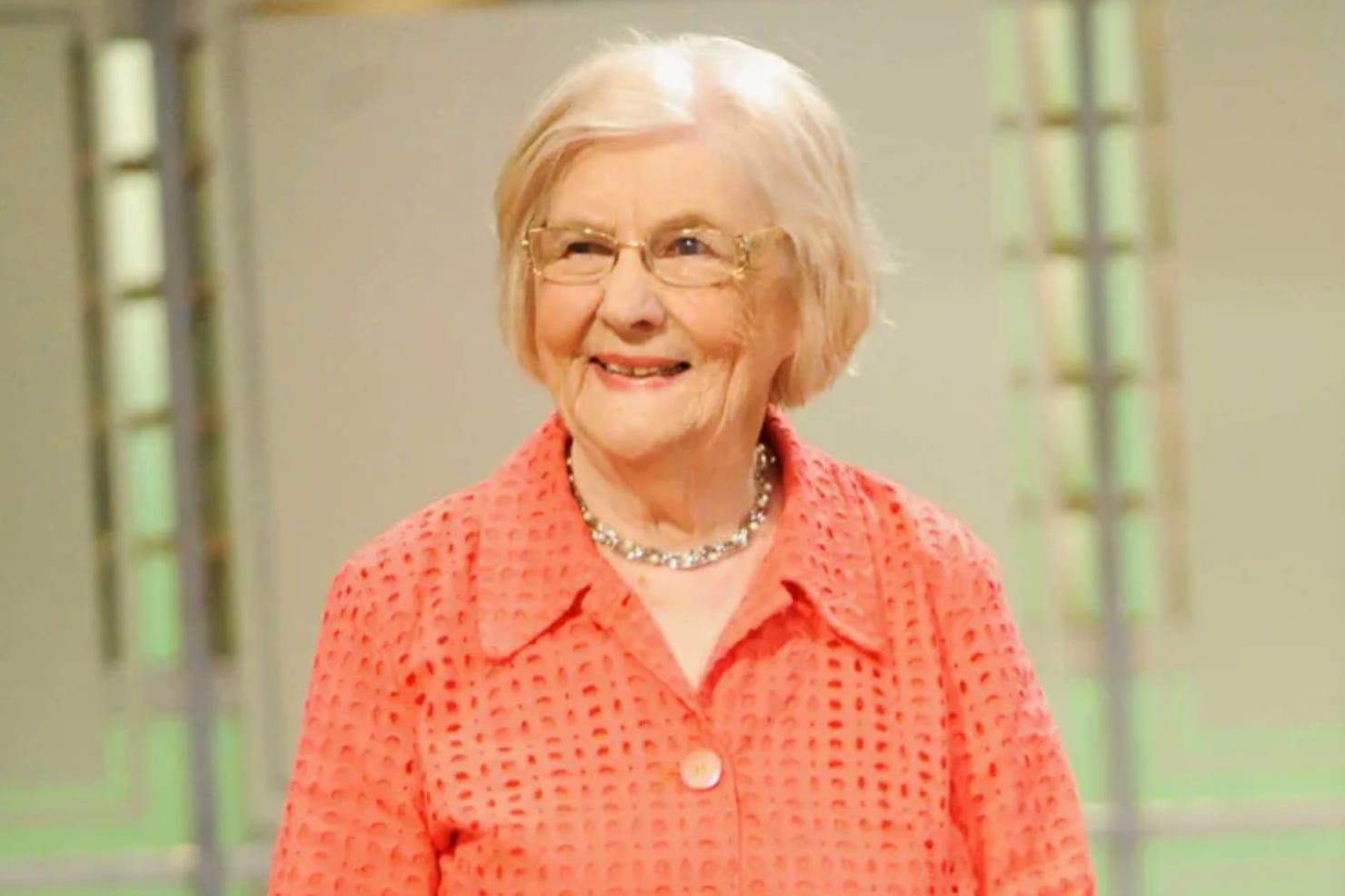
The woman pictured above is Marilyn Hagerty. She died this week at 99.
If you don’t recognize her name, you may know her work. In 2012 her earnest review of a midwestern Olive Garden went viral. “The place is impressive,” Hagerty wrote. “It's fashioned in Tuscan farmhouse style with a welcoming entryway. There is seating for those who are waiting.”
She called the establishment “the largest and most beautiful restaurant now operating in Grand Forks.”
It is genuinely a beautiful piece of simple, direct food journalism.
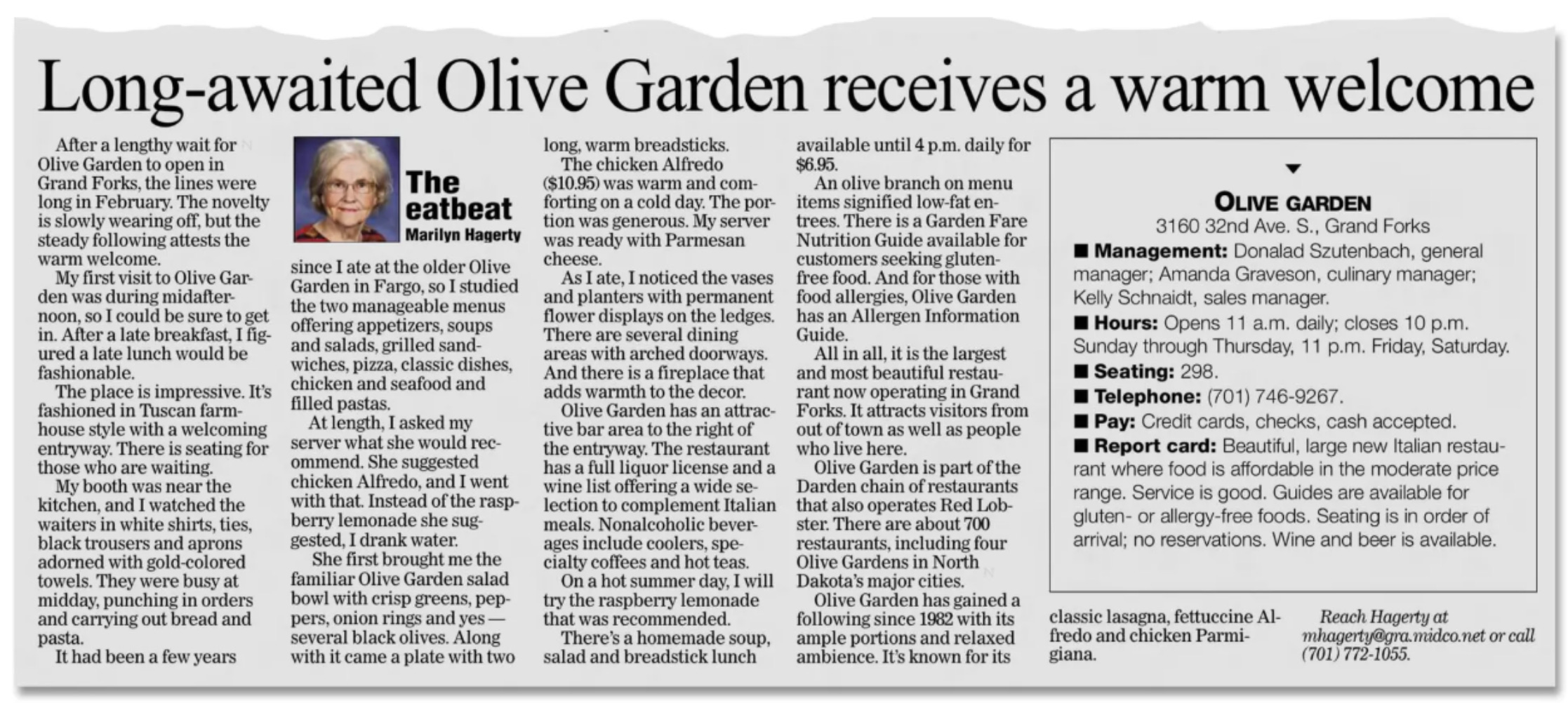
First, people mocked the column. Then Anthony Bourdain came to her defense and the tide shifted dramatically. People suddenly loved her review and celebrated it for its sweetness. She published a book under Bourdain’s imprint a year later.
As I read her obituary this week, I kept thinking about another viral restaurant review: that scathing New York Times takedown of Guy Fieri’s Times Square restaurant.
That piece, written by the Times’ restaurant critic Pete Wells, is entirely composed as a series of questions. Here’s how it opens:
Guy Fieri, have you eaten at your new restaurant in Times Square? Have you pulled up one of the 500 seats at Guy’s American Kitchen & Bar and ordered a meal? Did you eat the food? Did it live up to your expectations?
Did panic grip your soul as you stared into the whirling hypno wheel of the menu, where adjectives and nouns spin in a crazy vortex?
It is, in terms of creative writing, a well-constructed piece of work. It’s funny, smart, and dripping with snark.
Wells’ review, too, went viral. I remember it being widely shared in my circles on Facebook with glee.
These two distinct pieces of food journalism were published in the same year. Hagerty’s column came out in March 2012, the New York Times takedown was published just eight months later.
Looking back, the virality of Hagerty’s piece feels more reflective of our affinity for a cute rarity than our foundational appreciation of the mundane. It’s akin to our blind devotion to protecting someone like Betty White “at all costs” in the 2010s while simultaneously bathing in the snark of Twitter. Plus, it’s unlikely people would have embraced her writing without Bourdain’s interference—something Hagerty herself acknowledged. Wells’ review, on the other hand, was like a bellwether for what would soon be the official language of the online world.
It is as if these two pieces were a digital fork in the road offering us two very different internet cultures. Which one did we want? Marilyn Hagerty’s earnest, kind, simple reviews, or Pete Wells’ snarky, deliciously composed takedowns. It’s clear which one we chose, but I so often wish we had opted for the other.
There is a lovely, tiny, poetic coda here that I literally just discovered. The Times’ obituary of Hagerty is a beautifully written, earnest testament to her life and work. As I reread it to link it here I wanted to know who wrote it. It was Pete Wells.
Neither of these viral moments were on my radar at all—I really love what you shared here and your assessment of our online selves. Wonderful work as always, Dylan.
Oh wow, the ending of the post made me pause! What a nice connection.